Tuesday, 1 October 2019

You purchase 120 shares for $40 a share ($4,800), and after a year the price falls to $35. Calculate the

You purchase 120 shares for $40 a share ($4,800), and after a year the price falls to $35. Calculate the percentage return on your investment if you bought the stock on margin and the margin requirement was (ignore commissions, dividends, and interest expense):
15 percent. Use a minus sign to enter the amount as a negative value. Round your answer to one decimal place.
55 percent. Use a minus sign to enter the amount as a negative value. Round your answer to one decimal place.
80 percent. Use a minus sign to enter the amount as a negative value. Round your answer to one decimal place.

You purchase 120 shares for $40 a share ($4,800), and after a year the price falls to $35. Calculate the

You purchase 120 shares for $40 a share ($4,800), and after a year the price falls to $35. Calculate the percentage return on your investment if you bought the stock on margin and the margin requirement was (ignore commissions, dividends, and interest expense):
15 percent. Use a minus sign to enter the amount as a negative value. Round your answer to one decimal place.
55 percent. Use a minus sign to enter the amount as a negative value. Round your answer to one decimal place.
80 percent. Use a minus sign to enter the amount as a negative value. Round your answer to one decimal place.

The SGS Co. had $258,000 in taxable income. Use the rates from Table 2.3. (Do not round intermediate

The SGS Co. had $258,000 in taxable income. Use the rates from Table 2.3. (Do not round intermediate calculations and round your answer to the nearest whole number, e.g., 32.) Calculate the company’s income taxes. Income taxes = $

) In a market with three assets, the portfolios P1 = (0.6, 0.3, 0.1) and P2 = (- 0.2, 0.5, 0.7) lie on the

) In a market with three assets, the portfolios P1 = (0.6, 0.3, 0.1) and P2 = (- 0.2, 0.5, 0.7) lie on the Minimum Variance Set. The portfolios have returns 12% and 4% respectively.
a) Find the portfolio on the MVS with return 14%.
b) Does the portfolio P = (0.1, 0.4, 0.5) lie on the MVS ? Explain.

2) At end of Day 1, I invest equal amounts of money in shares of company A and B.

2) At end of Day 1, I invest equal amounts of money in shares of company A and B.
By end of Day 2, the price of company A shares has doubled and the price of company B shares has halved (compared to Day 1 price).
  • What is the return on my entire investment from Day 1 to Day 2 ?
  • What are the weights of my portfolio at the end of Day 2 ?
  • At the end of Day 3, the price of company A shares has halved and the price of company B shares has quadrupled (compared to Day 2 price).
What is the return on my investment from end of Day 1 to end of Day 3 ?

The owners of a small manufacturing company have hired a manager to run the company with the

The owners of a small manufacturing company have hired a manager to run the company with the expectation that the new manager will buy the company after 3 years. Compensation of the new vice president is a flat salary of $100,000 plus 50% of the first $200,000 profit, then 10% of profit over $200,000. When the new manager purchases the company, he will be required to pay 5 times the average annual profitability of the 3 year period. 1. Plot the annual compensation of the VP as a function of annual profit. (Place profit on the horizontal axis and compensation on the vertical axis.) 2. Assume the company will be worth $10 million in 3 years. Plot the profit of buying the company as a function of annual profit. (Profit from purchase= Value – Price Paid) 3. Does this contract align the incentives of the new VP with the profitability goals of the current owners? 4. Redesign the contract to better align the incentives of the new VP with the profitability goals of the owners.

Consider two loans with a​ 1-year maturity and identical face​ values: a(n) 7.8 % loan with a 0.99% loan

Consider two loans with a​ 1-year maturity and identical face​ values: a(n) 7.8 % loan with a 0.99% loan origination fee and​ a(n) 7.8% loan with a 5.1% ​(no-interest) compensating balance requirement. Which loan would have the higher effective annual rate ​ (EAR)? Why?
The EAR in the first case is ____%.
​(Round to one decimal​ place.)
The EAR in the second case is ____%.
(Round to one decimal place.)
Which loan would cost the most? ______.

The rates of return on Cherry Jalopies, Inc., stock over the last five years were 23 percent, 11 percent, -5

The rates of return on Cherry Jalopies, Inc., stock over the last five years were 23 percent, 11 percent, -5 percent, 7 percent, and 10 percent. Over the same period, the returns on Straw Construction Company's stock were 16 percent, 24 percent, -6 percent, 2 percent and 16 percent. Calculate both the variances and standard variances for Cherry and Straw.

The rates of return on Cherry Jalopies, Inc., stock over the last five years were 23 percent, 11 percent, -5

The rates of return on Cherry Jalopies, Inc., stock over the last five years were 23 percent, 11 percent, -5 percent, 7 percent, and 10 percent. Over the same period, the returns on Straw Construction Company's stock were 16 percent, 24 percent, -6 percent, 2 percent and 16 percent. Calculate both the variances and standard variances for Cherry and Straw.

Which one of the following statements is correct concerning the NYSE?

Which one of the following statements is correct concerning the NYSE?
Multiple Choice
  • The publicly traded shares of a NYSE-listed firm must be worth at least $250 million.
  • The NYSE is the largest dealer market for listed securities in the United States.
  • The listing requirements for the NYSE are more stringent than those of NASDAQ.
  • Any corporation desiring to be listed on the NYSE can do so for a fee.
  • The NYSE is an OTC market functioning as both a primary and a secondary market.

1.Suppose bank 1 offers a stated annual rate of interest equal to r1 compounded semiannually and bank 2

1.Suppose bank 1 offers a stated annual rate of interest equal to r1 compounded semiannually and bank 2 offers a stated annual rate of interest equal to r2 compounded continuously. If r2 = 12.0307846 %, what would r1 have to be such that both banks are offering the same annual effective rate of interest?
2. Would you rather receive $5,000 today or $10,000 in 12 years if the discount rate is 6.4 percent compounded semiannually? At what stated annual rate compounded semiannually would you be indifferent between the two alternatives?

NoGrowth Corporation currently pays a dividend of $ 0.59 per​ quarter, and it will continue to pay this

NoGrowth Corporation currently pays a dividend of $ 0.59 per​ quarter, and it will continue to pay this dividend forever. What is the price per share of NoGrowth stock if the​ firm's equity cost of capital is 14.1 %
The stock price is​ $[...]? ​ (Round to the nearest​ cent.)

Babu Baradwaj is saving for his son's college tuition. His son is currently 11 years old and will begin college

Babu Baradwaj is saving for his son's college tuition. His son is currently 11 years old and will begin college in seven years. Babu has an index fund investment worth $7,500 that is earning 9.5 percent annually. Total expenses at the University of Maryland, where his son says he plans to go, currently total $15,000 per year but are expected to grow at roughly 6 percent each year. Babu plans to invest in a mutual fund that will earn 11 percent annually to make up the difference between the college expenses and his current savings. In total, Babu will make seven equal investments with the first starting today and the last being made a year before his son begins college.
  1. What will be the present value of the four years of college expenses at the time that Babu's son starts college? Assume a discount rate of 5.5 percent.
  2. What will the value of the index mutual fund be when his son just starts college?
  3. What is the amount that Babu will have to have saved when his son turns 18 if Babu plans to cover all of his son's college expenses?
  4. How much will Babu have to invest every year in order to have enough funds to cover all his son's expenses?

An internal control system consists of the policies and procedures managers use to do all of the following

An internal control system consists of the policies and procedures managers use to do all of the following except:
Multiple Choice
  • Urge adherence to company policies.
  • Ensure reliable accounting.
  • Promote efficient operations.
  • Protect assets.
  • Determine pricing for products.

Babu Baradwaj is saving for his son’s college tuition. His son is currently 11 years old and will begin college

Babu Baradwaj is saving for his son’s college tuition. His son is currently 11 years old and will begin college in seven years. Babu has an index fund investment of $7,500 that is earning 9.5 percent annually. Total expenses at the University of Maryland, where his son says he plans to go, currently total $15,000 per year, but are expected to grow at roughly 6 percent each year. Babu plans to invest in a mutual fund that will earn 11 percent annually to make up the difference between the college expenses and his current savings. In total, Babu will make seven equal investments with the first starting today and with the last being made a year before his son begins college.
a. What will be the present value of the four years of college expenses at the time that Babu’s son starts college? Assume a discount rate of 5.5 percent.
b. What will be the value of the index mutual fund when his son just starts college?
c. What is the amount that Babu will have to have saved when his son turns 18 if Babu plans to cover all of his son’s college expenses?
d. How much will Babu have to invest every year in order to have enough funds to cover all his son’s expenses?

The ratio which includes all debts of all maturities to all account receivables is called the: cash coverage ratio.

The ratio which includes all debts of all maturities to all account receivables is called the: cash coverage ratio. times interest earned ratio. equity multiplier. Total debt ratio.

The ratio which includes all debts of all maturities to all account receivables is called the: cash coverage ratio.

The ratio which includes all debts of all maturities to all account receivables is called the: cash coverage ratio. times interest earned ratio. equity multiplier. Total debt ratio.

An auction market: handles primary market transactions exclusively. has a physical trading floor. is also

An auction market: handles primary market transactions exclusively. has a physical trading floor. is also referred to as an OTC market. is dealer-based market.

Suppose the prices of one-year, two-year, and three-year zero coupon bonds each with a par value of $100

Suppose the prices of one-year, two-year, and three-year zero coupon bonds each with a par value of $100 are $90$, $80, and $70, respectively.
The treasury is considering issuing and three-year par bond. Use the given information on zero coupon bonds, to the coupon rate at which the bond would sell for par (solve for the coupon rate at which the value of the bond equals par).

In the schedule below are annualized returns over various periods for selected bond managers through

In the schedule below are annualized returns over various periods for selected bond managers through December 2009.
For example, Manager A (Pimco) has earned gross returns of 7.52% annually, from 2000 to 2009 (10 years), and in 2009, earned 12.92%. The Barclays Capital Aggregate benchmark earned 6.33% and 5.93% over the same two periods, respectively. Pimco’s alpha over the ten year period was 0.80%. Pimco’s information ratio during 2009 was 3.19, which represents its monthly return spread over the benchmark return divided by the standard deviation of returns over the 12 month period. Pimco’s Sharpe ratio for the four year return period was 1.08, which represents Pimco’s excess monthly returns over the risk free rate divided by the standard deviation of its monthly returns over the 48 month time period.
  1. Which manager has the most risk? Why?
  2. Which manager has the least risk? Why?
  3. Which fund has the best performance?

Suppose the prices of one-year, two-year, and three-year zero coupon bonds each with a par value of $100

Suppose the prices of one-year, two-year, and three-year zero coupon bonds each with a par value of $100 are $90,$80, and $70, respectively.
A dealer has a three-year bond in her inventory with 10% coupon rate and par value of $1000. Use the given information on zero-coupon bonds to value this bond.

2D: Sensitivity Analysis For the following problems, calculate: A.) EV(d1) B.) EV(d2) C.) Best EMV D.)

2D: Sensitivity Analysis For the following problems, calculate: A.) EV(d1) B.) EV(d2) C.) Best EMV D.) EVwPI E.) EVPI F.) The value of probability of s1 (p) that is the cut off of changing the best decision. Draw a number line. G.) The value for which the payoff of the strong demand (S) that is the cutoff for changing the best decision. H.) The value for which the payoff of the weak demand (W) that is the cutoff for changing the best decision. I.) Analyze the scenario and explain what the results mean. Respond to the suggested thought. PLEASE SHOW WORK Round all probabilities to three decimal places and all EV to one decimal place. d1= build small complex, d2 = build large complex s1 = strong demand, s2 = weak demand Scenario: The economy is bad and a weak demand is likely. Think about, even in this situation, when a large complex should still be built. p(s1) = 0.3 p(s2) = 0.7 s1 s2 d1 11 10 d2 14 6 Scenario: We are unable to get a prediction of the demand, so we go with 50/50. Think about how close EV(d1) is to EV(d2) and how this influences the problem.

The daily financial operations of a firm are primarily controlled by managing the: total debt level. working

The daily financial operations of a firm are primarily controlled by managing the: total debt level. working capital. capital structure. capital budget.

Suppose the prices of one-year, two-year, and three-year zero coupon bonds each with a par value of $100

Suppose the prices of one-year, two-year, and three-year zero coupon bonds each with a par value of $100 are $90, $80, and $70, respectively.
Compute the three spot rates.

Kristi is considering an investment that will pay $5000 a year for seven years, starting one year from today.

Kristi is considering an investment that will pay $5000 a year for seven years, starting one year from today. How much should she pay for this investment if she wishes to earn a 12% rate of return?

If you were offered the chance of an investment in a mango orchard in North Queensland and you were

If you were offered the chance of an investment in a mango orchard in North Queensland and you were promised a return of $12 000 at the end of each year for the next 10 years, what is the maximum amount you would be prepared to pay for such an investment if you required a return of 12%?

Suppose the prices of one-year, two-year, and three-year zero coupon bonds each with a par value of $100

Suppose the prices of one-year, two-year, and three-year zero coupon bonds each with a par value of $100 are $90,$80, and $70, respectively.
Form a portfolio of zero coupon bonds that replicates a three-year $100 annuity.

f you were offered the chance of an investment in a mango orchard in North Queensland and you were

f you were offered the chance of an investment in a mango orchard in North Queensland and you were promised a return of $12 000 at the end of each year for the next 10 years, what is the maximum amount you would be prepared to pay for such an investment if you required a return of 12%?


$107 143


$210 584


$87 603


$67 803     

Finance is exciting! In this course, we learned how money can grow through the use of compounding and

Finance is exciting! In this course, we learned how money can grow through the use of compounding and interest rates and your growth strategies may now be different. What are your new financial goals? Would you like to become more liquid, to save more for your retirement, or to start a new business? Whatever your goals, finance is right at the core. Think about what you learned in this course regarding investing to complete this assignment.
Write a two to three (2-3) page paper in which you:
  1. Describe (3) ways you will invest in your future based on the principles of finance discussed in this course. Include terminology from the course and use citations as necessary to support your explanation of the terminology.
  2. Discuss one of the (3) ways you feel most confident as a way to invest in your future. Explain your level of confidence.
  3. Of the (3) ways you will invest in your future, discuss the one you perceive might be the most challenging. Then, discuss how you might overcome some of those challenges.

the stock price is currently $80. The stock price annual up-move factor is 1.15. The risk free rate is 3.9%.

the stock price is currently $80. The stock price annual up-move factor is 1.15. The risk free rate is 3.9%. Compute the value of a 2 year European call option with an exercise price of $62 using a two-step binomial model

The implication that consumers want to buy the best possible product (best performance, highest quality,

1. The implication that consumers want to buy the best possible product (best performance, highest quality, latest technology), and as an outcome of the ______ orientation.
a. Product
b. Marketing
c. Sales
d. Production
e. Societal Marketing
2. The total revenue of a firm is calculated by multiplying the number of units sold by the ___ of each unit.

Jeremy earned $100,000 in salary and $6,000 in interest income during the year. Jeremy’s employer

Jeremy earned $100,000 in salary and $6,000 in interest income during the year. Jeremy’s employer withheld $11,000 of federal income taxes from Jeremy’s paychecks during the year. Jeremy has one qualifying dependent child who lives with him. Jeremy qualifies to file as head of household and has $23,000 in itemized deductions.
Determine Jeremy’s tax refund or taxes due.

What is the difference between trend and comparative analysis? When would an analysis choose the

What is the difference between trend and comparative analysis?  When would an analysis choose the importance of trends versus comparative evaluations and why?

How do you calculate ''Net increase in cash" & "Cash End of the year" for cash flow statement from balance

How do you calculate ''Net increase in cash" & "Cash End of the year" for cash flow statement from balance sheet and income statement?

Hand-to-Mouth (H2M) is currently​ cash-constrained, and must make a decision about whether to delay

Hand-to-Mouth (H2M) is currently​ cash-constrained, and must make a decision about whether to delay paying one of its​ suppliers, or take out a loan. They owe the supplier $ 12 comma 500 with terms of 2.4​/10 Net​ 40, so the supplier will give them a 2.4 % discount if they pay by today​ (when the discount period​ expires). ​ Alternatively, they can pay the full $ 12,500 in one month when the invoice is due. H2M is considering three​ options:
Alternative​ A: Forgo the discount on its trade credit​ agreement, wait and pay the full $ 12,500 in one month.
Alternative​ B: Borrow the money needed to pay its supplier today from Bank​ A, which has offered a​ one-month loan at an APR of 12.4 %. The bank will require a​ (no-interest) compensating balance of 4.6 % of the face value of the loan and will charge a $ 90 loan origination fee. Because H2M has no​ cash, it will need to borrow the funds to cover these additional amounts as well.
Alternative​ C: Borrow the money needed to pay its supplier today from Bank​ B, which has offered a​ one-month loan at an APR of 14.9 %. The loan has a 1.3 % loan origination​ fee, which again H2M will need to borrow to cover.

The College of Business at Northeast College is accumulating data as a first step in the preparation of next

The College of Business at Northeast College is accumulating data as a first step in the preparation of next year's budget development. One cost that is being looked at closely is administrative costs as a function of student credit hours. Data on administrative costs and credit hours for the past thirteen months are shown below: Month Administrative Costs Credit Hours July $ 129,301 250 August 82,613 115 September 225,580 1,392 October 216,394 1,000 November 258,263 1,309 December 184,449 1,112 January 219,137 1,339 February 245,000 1,373 March 209,462 1,064 April 191,925 1,123 May 249,978 1,360 June 170,418 420 July 128,167 315 Total $ 2,510,687 12,172 Average $ 193,130 936 The controller's office has analyzed the data and has given you the results from the regression analysis: SUMMARY OUTPUT Regression Statistics Multiple R 0.9317157 R Square 0.868094147 Adjusted R Square 0.856102705 Standard Error 20,134.92395 Observations 13 ANOVA df SS MS F Significance F Regression 1 29,349,143,514 29,349,143,514 72.3928117 3.61909E-06 Residual 11 4,459,566,787 405,415,162.4 Total 12 33,808,710,301 Coefficients Standard Error t Stat P-value Lower 95% Upper 95% Lower 95.0% Upper 95.0% Intercept 96,647.02398 12,641.66539 7.64511803 1.00291E-05 68,822.90608 124,471.1419 68,822.90608 124,471.1419 X Variable 1 103.0607697 12.11283103 8.508396541 3.61909E-06 76.40060833 129.720931 76.40060833 129.720931
The percent of the total variance that can be explained by the regression is:
93.3%. 86.8%. 85.9%. 96.6%.

A private company just acquired a new software to do in-house accounting. The company paid

A private company just acquired a new software to do in-house accounting. The company paid $13,000 for the software. Annual upgrades over next 3 years will cost company $1,500 per year. Software belongs to Class 10 of the Canadian CCA system with the CCA rate of 30%. Calculate the PW of the tax savings in year 2 due to the CCA system under annual MARR of 5% and corporate tax rate of 10.5%.

Venture capital financing is a type of funding which assembles cash from investors and lends it to startup

Venture capital financing is a type of funding which assembles cash from investors and lends it to startup businesses that have high potential for success. Venture capital investments usually encompass very high risk; however, the reward has the potential to exceed the risk. The process for acquiring venture capital financing sometimes is complicated, but generally there are five stages in the process of procuring venture capital financing.
  • Discuss the five main stages in the process of venture capital financing.

Please give us one example from your research, work, or personal life of an application of Liquidity, asset

Please give us one example from your research, work, or personal life of an application of Liquidity, asset management, financial leverage, profitability and market value as well as the DuPont Identity (formula).

Historically, over the years Singapore has drawn the attention of many businessmen and investors from

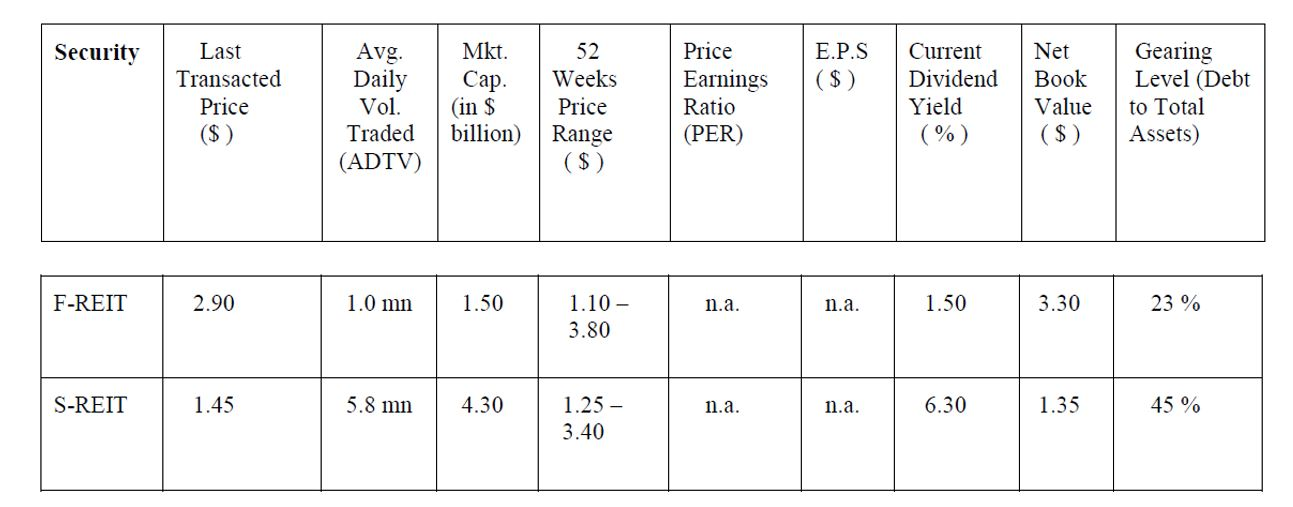
Historically, over the years Singapore has drawn the attention of many businessmen and investors from overseas based on its tremendous and continuous growth and successes. Ms. A, who is one such foreign investor, came across various news reports since the beginning of the year that a large number of foreigners are already invested or are showing a keen interest in the Singapore real estate sector. As an ultra-high net worth individual (UHNWI) investor herself with at least an equivalent of SGD 500 million in net investable assets, Ms. A has now decided to allocate SGD 10 million in cash to invest in Singapore real estate but is clueless as to the wide range of choices available in the real estate sector and related investment opportunities here. Additional information on the above securities that Ms. A is able to obtain are as follows:
1. XLL – a MNC with global hotel operations and mixed development assets (comprising commercial, retail and residential) including substantial local real estate operations.
2. UPL – a medium-sized developer with mainly residential projects in Singapore although it has diversified into Cambodia, Vietnam, Australia and the UK over the last 3 years.
3. F-REIT – Its assets comprise mainly industrial factories and warehouses, purpose-built storage and data centres, logistic hubs and distribution facilities.
4. S-REIT – Its portfolio consists of mainly retail malls, and some Grade A office and commercial space in prime CBD areas.
Mkt Security Price E.P.S Current Dividend Gearing Level (Debt to Total Last Avg. Daily Vol Traded 52 Net Cap (in $ billion) WRemarks:
F-Reits - its portfolio consists mainly of industrial factories and warehouses
S-Reits - Assets comprise mainly retail malls and Grade A office space
Analyse the market capitalization, liquidity, earnings, book values, and income distribution. Which option is a better investment for Mrs. B?

To provide a consistent frame of reference for the company’s financial statements and ratios, assume that the

To provide a consistent frame of reference for the company’s financial statements and ratios, assume that the following balance sheet and income statement reflect the company’s pre-transaction condition and performance.
Phoenix Golf Club Co.’s Pre transaction Statement of Financial Condition
Cash $15,000 Accounts payable $20,000
Marketable securities 10,000 Wages payable 20,000
Accounts receivable 470,000 Taxes payable 10,000
Inventory 500,000 Notes payable 50,000
Prepaid expenses 5,000 Total current liabilities 100,000
Total current assets 1,000,000 Long-term debt 500,000


Total liabilities 600,000
Gross plant and equipment 1,500,000 Common stock 150,000
Accumulated depreciation 500,000 Capital paid in excess of par 350,000
Net plant and equipment 1,000,000 Retained earnings 900,000


Total equity 1,400,000
Total assets $2,000,000 Total debt and equity $2,000,000
Phoenix Golf Club Co.’s Pre transaction Statement of Financial Performance
Sales $5,000,000
Less: Cost of goods sold¹ 2,000,000
Gross profit 3,000,000
Less: Operating expenses 600,000
Operating profit (EBIT) 2,400,000
Less: Interest expense² 33,000
Earnings before taxes (EBT) 2,367,000
Less: Tax expense³ 828,450
Net income $1,538,550
¹Cost of goods sold equals 40% of sales.
²Interest expense equals 6% of the combined notes payable and long-term debt balances.
³The average federal and state tax rate is 35%.
Indicate if any of the listed financial statement accounts is affected by the following business transactions and whether the listed ratios will increase, decrease, or remain unchanged as a result of the transaction. (Hint: Assume that the business transaction occurs exactly as stated without interpreting it further. Do not consider any related transactions that may occur before or after the specified transaction. Assume there are 365 days in a year.)
Business Transaction 1
Phoenix Golf Club Co. (PGC) sells 25,000 shares of new common stock ($1 per share par value) to new and existing shareholders for $20 per share.
Financial Account
Check if the Account Is Affected by the Specified Transaction
Cash

Operating income

Long-term debt

Common stock

Capital paid-in excess of par

Financial Ratio
Ratio’s Behavior
Inventory turnover
Debt ratio
Times interest earned   
Operating profit margin
Basic earnings power
Current ratio
Business Transaction 2
Phoenix Golf Club Co. (PGC) switches from holding an available inventory to a just-in-time inventory system, thereby reducing its inventory by 80.00%.
Financial Account
Check if the Account Is Affected by the Specified Transaction
Inventory

Accounts payable

Prepaid expenses

Total assets

Common stock

Financial Ratio
Ratio’s Behavior
Average collection period   
Inventory turnover   
Fixed assets turnover
Quick ratio   
Return on assets
Debt ratio

A 5-year Treasury bond has a 4.75% yield. A 10-year Treasury bond yields 6.15%, and a 10-year

A 5-year Treasury bond has a 4.75% yield. A 10-year Treasury bond yields 6.15%, and a 10-year corporate bond yields 8.6%. The market expects that inflation will average 2.85% over the next 10 years (IP10 = 2.85%). Assume that there is no maturity risk premium (MRP = 0) and that the annual real risk-free rate, r*, will remain constant over the next 10 years. (Hint: Remember that the default risk premium and the liquidity premium are zero for Treasury securities: DRP = LP = 0.) A 5-year corporate bond has the same default risk premium and liquidity premium as the 10-year corporate bond described.
What is the yield on this 5-year corporate bond? Round your answer to two decimal places.

The Price is Right! Utilizing 1 of these public companies—Target, Coke, Pepsi, Wal-Mart, or J. P. Morgan

The Price is Right! Utilizing 1 of these public companies—Target, Coke, Pepsi, Wal-Mart, or J. P. Morgan—determine the right price for that company’s stock in the following 5 easy steps: Visit this Web site. Type in your selected company’s name in the Quote Search box, and select your company's stock symbol. Jot down the current stock price. Select the Analysis tab, and find the Analyst Recommendation box. Jot down the stock’s Earnings Per Share (EPS) Estimate. Select the Price Ratios tab, and jot down the current Price to Earnings Ratio (P/E) for the industry (not the company). Using the PE valuation model to determine the right price for this stock, multiply the industry average P/E ratio by the stock’s EPS to estimate the intrinsic price of the stock. Answer the following questions: Is this stock overvalued or undervalued when compared to the current stock price? What are the analysts’ recommendations for this stock (buy, sell, or hold)? Do you agree with them? Would you consider purchasing this stock? Why?

n this unit we learned to conduct a retirement needs analysis taking into account various assumptions such as

n this unit we learned to conduct a retirement needs analysis taking into account various assumptions such as inflation rate, retirement period, life expectancy, income sources, and other variables, and determine financial needs during the accumulation and retirement period. Lets extend the discussion by examining the practical implications of these concepts. TIAA-CREF has an excellent site that provides a consider- able amount of information on retirement planning and retirement options. Visit the site at tiaa-cref.org click on the What We Offer tab, and examine the information in the Retirement section.

I was doing some work for an organization that served as a group health plan administrator -- they

I was doing some work for an organization that served as a group health plan administrator -- they processed enrollments, terminations, and monthly billings, but simply charged each member company a set monthly fee per covered person. Some of the member companies were long-standing little mom & pop businesses -- they had the same employees year after year. Other member companies were in food service and tourism with something like 20% employee turnover each month -- lots of enrollments and terminations to process. The plan administrator organization was having difficulty making ends meet. Can you see what processes were eating up their resources? How might ABC help you restructure the monthly fee billing?

I was doing some work for an organization that served as a group health plan administrator -- they

I was doing some work for an organization that served as a group health plan administrator -- they processed enrollments, terminations, and monthly billings, but simply charged each member company a set monthly fee per covered person. Some of the member companies were long-standing little mom & pop businesses -- they had the same employees year after year. Other member companies were in food service and tourism with something like 20% employee turnover each month -- lots of enrollments and terminations to process. The plan administrator organization was having difficulty making ends meet. Can you see what processes were eating up their resources? How might ABC help you restructure the monthly fee billing?


As a member of UA Corporation's financial staff, you must estimate the Year 1 cash flow for a proposed

As a member of UA Corporation's financial staff, you must estimate the Year 1 cash flow for a proposed project with the following data. What is the Year 1 cash flow? (Hint: There may be redundant information given. Make sure that you only include relevant quantities in your calculations)
Sales revenues, each year $42,500 
Depreciation $10,000
Other operating costs $17,000
Interest expense $4,000
Tax rate  35.0%
a. $16,351
b. $17,212
c. $18,118
d. $19,071
e. $20,075

Apple stock is listed both on NASDAQ and London stock exchange. Assume that you are able to trade on

Apple stock is listed both on NASDAQ and London stock exchange. Assume that you are able to trade on both exchanges simultaneously and you observe a discrepancy between prices across the two exchanges as follows. The NASDAQ price is $157.21 and the LSE price (after conversion to dollars) is $159.10. Which of the following strategies would be an arbitrage trade?
a. Buy shares on NASDAQ and shortsell same number of shares on LSE
b. Shortsell shares on NASDAQ and buyuy same number of shares on LSE c. Buy shares on NASDAQ and buy same number of shares on LSE
d. Shortsell shares on NASDAQ and shortsell same number of shares on LSE

Historically, over the years Singapore has drawn the attention of many businessmen and investors from

Historically, over the years Singapore has drawn the attention of many businessmen and investors from overseas based on its tremendous and continuous growth and successes. Ms. A, who is one such foreign investor, came across various news reports since the beginning of the year that a large number of foreigners are already invested or are showing a keen interest in the Singapore real estate sector. As an ultra-high net worth individual (UHNWI) investor herself with at least an equivalent of SGD 500 million in net investable assets, Ms. A has now decided to allocate SGD 10 million in cash to invest in Singapore real estate but is clueless as to the wide range of choices available in the real estate sector and related investment opportunities here.

A put option gives its owner the _____ to _____ a stock at a predetermined strike price.

A put option gives its owner the _____ to _____ a stock at a predetermined strike price.
  1. right/buy
  2. right/sell
  3. obligation/buy
  4. obligation/sell

The rates of return on Cherry Jalopies, Inc., stock over the last five years were 18 percent, 11 percent, −1

The rates of return on Cherry Jalopies, Inc., stock over the last five years were 18 percent, 11 percent, −1 percent, 2 percent, and 11 percent. Over the same period, the returns on Straw Construction Company’s stock were 16 percent, 19 percent, −5 percent, 2 percent, and 21 percent.
Calculate the variances and the standard deviations for Cherry and Straw. (Do not round intermediate calculations. Enter your variance as a decimal rounded to 5 decimal places. Enter your standard deviation as a percent rounded to 2 decimal places.)

The Treasury auctioned $1.0 billion par value 91-day T-bills, the following competitive bids were received:

The Treasury auctioned $1.0 billion par value 91-day T-bills, the following competitive bids were received:
1. BID 1 100 Million at 0,995
2. BID 2 300 Million at 0,990
3. BID 3 200 Million at 0,994
4. 500 Million in Non Competitive Bids. (Noncompetitive Bidders pay the same price paid by competitive bidders. The significant difference between the two methods is that competitive bidders may or may not end up buying securities, whereas the noncompetitive bidders are guaranteed to do so.)
  If only these competitive bids are received, who will receive T-bills, in what quantity, and at what price?

The Treasury auctioned $1.0 billion par value 91-day T-bills, the following competitive bids were received:

The Treasury auctioned $1.0 billion par value 91-day T-bills, the following competitive bids were received:
1. BID 1 100 Million at 0,995
2. BID 2 300 Million at 0,990
3. BID 3 200 Million at 0,994
4. 500 Million in Non Competitive Bids. (Noncompetitive Bidders pay the same price paid by competitive bidders. The significant difference between the two methods is that competitive bidders may or may not end up buying securities, whereas the noncompetitive bidders are guaranteed to do so.)
  If only these competitive bids are received, who will receive T-bills, in what quantity, and at what price?

Indicate and Discuss how will be affected the prices (and the yields) of the next Bonds (no calculations

Indicate and Discuss how will be affected the prices (and the yields) of the next Bonds (no calculations required) i. US Treasury Bonds with Moderate GDP Growth ii. German Government Bonds with Higher than expected GDP Growth iii. Investment Grade Corporate Bonds with Terrorist attack in London, NY. iv. Spanish, Italian and Portuguese Bonds with EU Debt Crisis v. High Yield Corporate Bonds with US Debt out of control due to Trump cutting Taxes.

Business and Corporations Law

Business and Corporations Law
5. Larry Large started a business in early 2001 involving direct marketing of a range of garden products. He operated through a proprietary company, Large Larry Pty Ltd. The business was quite successful, aided apparently by a media campaign featuring Larry himself. In 2017 he decided to dramatically expand the business and to change the operation from direct marketing to distribution of products through various retail outlets. In that year he converted the proprietary company into a public company (Large Larry Ltd). He now wants to raise $15 million in additional funds to assist with the expansion and also to retire some debt. One option that is being considered is to offer shares in Large Larry Ltd to a number of large institutional investors. An alternative option is to float the business, that is offer the shares to the public and apply for listing on the Australian Stock Exchange (ASX). Larry is very upbeat about the company’s prospects. He believes that with favourable economic conditions the company will double in size within a year. He approaches you and asks you to advise him on the following matters:
a) What are the implications under Chapter 6D of the Corporations Act of the two fundraising options being considered?
b) If a decision is made to carry out a float, what type of disclosure document will be required and what type of information must it contain?
c) If the offer document includes forecasts consistent with Larry’s view concerning the prospects of the company, what consequences could follow if the forecasts are not met?

Describe your company's annual budget process.

Describe your company's annual budget process.
  • What is your involvement in the process?
  • What works well? What doesn't work?
  • If you were CEO/CFO, what changes would you make and why?
  • How would you communicate to employees the value that the process brings to the business?

Predict what will happen to interest rates on corporate bonds if governments adopt a new regulation that

Predict what will happen to interest rates on corporate bonds if governments adopt a new regulation that guarantees payment of principal in case of default in order to encourage investment in corporate bonds. Will it affect the demand for Treasury securities?

I found a solution to my assignment, because Im no accountant, I'm trying to work it backwards and I don't

I found a solution to my assignment, because Im no accountant, I'm trying to work it backwards and I don't understand the figures. Worse part of the solution has been cut off the page

There are four zero-coupon Treasury bonds as follows: Maturity (years) Price ($) 0.5 979.43 1.0 955.54

There are four zero-coupon Treasury bonds as follows: Maturity (years) Price ($) 0.5 979.43 1.0 955.54 1.5 928.60 2.0 897.17 Assume that the face values are $1000 for all the bonds. (a) Determine the quasi-modified duration for the given 1.0-year zero-coupon bond. (Keep 2 decimal places, e.g. xx.12) (b) The price for a 2-year Treasury note with semi-annual coupon payments is $ 987.42. Find the annual coupon rate for the note, and hence determine its quasi-modified duration. Coupon rate: % (Keep it in percentage format with 2 decimal places, e.g. xx.12%) Qusi-modified duration: (Keep 2 decimal places, e.g. xx.12)

Following are selected accounts for Staples, Inc., for the fiscal year ended January 30, 2016

Following are selected accounts for Staples, Inc., for the fiscal year ended January 30, 2016 (a) Indicate whether each account appears on the balance sheet (B) or income statement (I).
Staples, Inc. ($ millions) Amount Classification
Sales $21,059 AnswerBI
Accumulated depreciation 4,375 AnswerBI
Depreciation expense 388 AnswerBI
Retained earnings 6,900 AnswerBI
Net income 379 AnswerBI
Property, plant & equipment, net 1,586 AnswerBI
Selling, general and admin expense 4,600 AnswerBI
Accounts receivable 1,899 AnswerBI
Total liabilities 4,788 AnswerBI
Stockholders' equity 5,384 AnswerBI

(b) Using the data, compute total assets and total expenses.
Total Assets Answer
Total Expenses Answer
Constructing and Analyzing Balance Sheet Amounts from Incomplete Data
Selected balance sheet amounts for 3M Company, a manufacturer of consumer and business products, for three recent years follow.

(a) Compute the missing balance sheet amounts for each of the three years shown.
($ millions) Current
Assets
Long-term
Assets
Total
Assets
Current
Liabilities
Long-term
Liabilities
Total
Liabilities
Stockholders'
Equity
2013 $12,733 Answer $33,550 Answer $8,104 $15,602 $17,948
2014 12,303 18,906 Answer 5,964 12,103 Answer 13,142
2015 Answer 21,732 32,718 7,118 13,853 20,971 Answer


(b) What types of accounts would we expect to be included in current assets? In long-term assets?
Account Category
Accounts payable AnswerCurrent assetLong-term assetNeither
Accounts receivable AnswerCurrent assetLong-term assetNeither
Accrued expenses AnswerCurrent assetLong-term assetNeither
Cash AnswerCurrent assetLong-term assetNeither
Common stock AnswerCurrent assetLong-term assetNeither
Goodwill AnswerCurrent assetLong-term assetNeither
Inventories AnswerCurrent assetLong-term assetNeither
Prepaid expenses AnswerCurrent assetLong-term assetNeither
Property, plant and equipment AnswerCurrent assetLong-term assetNeither
Retained earnings AnswerCurrent assetLong-term assetNeither
Trademark Answer

Find a derivative or structured product from any issuer and explain it in plain English. Having done so, state

Find a derivative or structured product from any issuer and explain it in plain English. Having done so, state the problems you may have encountered in conveying the features to a client.
The successful submission will clearly and concisely explain the product in a manner appropriate for a retail client who is intelligent but not experienced with investments.

FinCorp’s free cash flow to the firm is reported as $295 million. The firm’s interest expense is $58 million.

FinCorp’s free cash flow to the firm is reported as $295 million. The firm’s interest expense is $58 million. Assume the tax rate is 35% and the net debt of the firm increases by $8 million. What is the market value of equity if the FCFE is projected to grow at 4% indefinitely and the cost of equity is 14%? (Do not round intermediate calculations. Enter your answer in millions rounded to 2 decimal places.)
  Market value $  million

In a market with three assets, the portfolios P1 = (0.6, 0.3, 0.1) and P2 = (- 0.2, 0.5, 0.7) lie on the

In a market with three assets, the portfolios P1 = (0.6, 0.3, 0.1) and P2 = (- 0.2, 0.5, 0.7) lie on the Minimum Variance Set. The portfolios have returns 12% and 4% respectively. a) Find the portfolio on the MVS with return 14%. b) Does the portfolio P = (0.1, 0.4, 0.5) lie on the MVS ?

Consider the graph below. Suppose that the discount factor is 0.80. Assume that cash flows occur at the

Consider the graph below. Suppose that the discount factor is 0.80. Assume that cash flows occur at the beginning of periods. (a) What is the optimal present value for the initial node A? (Keep your answer to 2 decimal places. e.g. xx.12.) (b) Highlight the optimal path in the graph.

Assume that the 1-year zero-coupon bond is sold at $88.97 and the yields to maturity for the coupon bonds

Assume that the 1-year zero-coupon bond is sold at $88.97 and the yields to maturity for the coupon bonds selling at market prices equal to their face values are 12% and 14% for 1-year and 1.5-year issues respectively. Coupons are paid every 6 months and face values are $100 for all the bonds.
(a) Calculate the spot rate curve (s0.5, s1, s1.5).
(Keep your answer in decimal format 4 decimal places, e.g. 0.1234. Do not give in percent format e.g. 12.34%.)
     s0.5:     s1:      s1.5 :
(b) Compute the quasi-modified duration for each of these bonds. (Keep 2 decimal places, e.g. xx.12.)
     Zero-coupon bond:
    12% coupon bond: 
    14% coupon bond: 
(c)  Determine the current price of an 10% coupon bond with face value $100 and 18 months to maturity. (Keep 2 decimal places, e.g. xx.12.)

FINANCIAL ANALYSIS The extracts of the financial statements of Micanfin Auto Spares (Pvt) Limited

FINANCIAL ANALYSIS The extracts of the financial statements of Micanfin Auto Spares (Pvt) Limited for 2017 are provided below: Extract of the Statement of Comprehensive Income for the year ended 31 December 2017. Sales (credit) 1 288 000 Less cost of sales 650 000 Gross profit 638 000 Less Operating expenses 360 000 Operating profit 278 000 Less interest expense 70 000 Profit before tax 208 000 Profit after tax 180 000 Extract of Statement of Financial Position as at 31 December 2017. Non-current assets 1 140 000 Inventories 266 000 Debtors 300 000 Bank 220 000 Total assets 1 926 000 Ordinary share capital 1 000 000 Retained earnings 482 000 Non-current liabilities 240 000 Creditors 215 000 Total liabilities 1 926 000

The extracts of the financial statements of Micanfin Auto Spares (Pvt) Limited for 2017 are provided

The extracts of the financial statements of Micanfin Auto Spares (Pvt) Limited for 2017 are provided
below:
Extract of the Statement of Comprehensive Income for the year ended 31 December 2017.
Sales (credit) 1 288 000
Less cost of sales 650 000
Gross profit 638 000
Less Operating expenses 360 000
Operating profit 278 000
Less interest expense 70 000
Profit before tax 208 000
Profit after tax 180 000
Extract of Statement of Financial Position as at 31 December 2017.
Non-current assets 1 140 000
Inventories 266 000
Debtors 300 000
Bank 220 000
Total assets 1 926 000
Ordinary share capital 1 000 000
Retained earnings 482 000
Non-current liabilities 240 000
Creditors 215 000
Total liabilities 1 926 000

The extracts of the financial statements of Micanfin Auto Spares (Pvt) Limited for 2017 are provided


The extracts of the financial statements of Micanfin Auto Spares (Pvt) Limited for 2017 are provided
below:
Extract of the Statement of Comprehensive Income for the year ended 31 December 2017.
Sales (credit) 1 288 000
Less cost of sales 650 000
Gross profit 638 000
Less Operating expenses 360 000
Operating profit 278 000
Less interest expense 70 000
Profit before tax 208 000
Profit after tax 180 000
Extract of Statement of Financial Position as at 31 December 2017.
Non-current assets 1 140 000
Inventories 266 000
Debtors 300 000
Bank 220 000
Total assets 1 926 000
Ordinary share capital 1 000 000
Retained earnings 482 000
Non-current liabilities 240 000
Creditors 215 000
Total liabilities 1 926 000
Required:
Calculate the following ratios for 2017. Where applicable, answers must be rounded off to two decimal places.
Profit margin
Interest cover
Debtors collection period
Current ratio
Acid test ratio
Return on own capital

Monday, 30 September 2019

The Holtzman Corporation has assets of $444,000, current liabilities of $51,000, and long-term liabilities of

The Holtzman Corporation has assets of $444,000, current liabilities of $51,000, and long-term liabilities of $71,000. There is $35,500 in preferred stock outstanding; 20,000 shares of common stock have been issued. 

a. Compute book value (net worth) per share. (Round your answer to 2 decimal places.)


b. If there is $25,700 in earnings available to common stockholders, and Holtzman’s stock has a P/E of 19 times earnings per share, what is the current price of the stock? (Do not round intermediate calculations. Round your final answer to 2 decimal places.)


c. What is the ratio of market value per share to book value per share? (Do not round intermediate calculations. Round your final answer to 2 decimal places.)


SOONER HEALTH NETWORK (the Network), which consists of five medical group practices, is a

SOONER HEALTH NETWORK (the Network), which consists of five medical group practices, is a subsidiary of not-for-profit Sooner Health System (the System). The Network includes both primary care and specialty physicians, with an emphasis on obstetrics/gynecology, eldercare, and pediatrics. Prior to the founding of the Network, the five practices operated independently.
The Network has three practice locations, each staffed with a mix of primary care and specialist physicians. Although the Network itself is only marginally profitable, it is an important contributor to the profitability of the System because it generates a large amount of revenues from referrals for both inpatient admissions and inpatient and outpatient ancillary services. In fact, each $1 of revenue generated within the Network is estimated to lead to $8 of inpatient and ancillary revenues to the System. By limiting the amount of ancillary services provided at the three Network locations, patients are forced (or at least encouraged) to use other System facilities for such services.
Still, some ancillary services are best performed at the Network locations for one or more of the following reasons: lower costs, increased physician efficiency, and improved patient convenience and hence better CAHPS (Consumer Assessment of Healthcare Providers and Systems) scores. For example, one of the practice locations now has a diagnostic imaging capability. When the scanner was moved from another facility to the Network location, volume increased, costs decreased, and both physician and patient satisfaction improved. (For more information on the CAHPS program, see www. ahrq .gov/ cahps/ about-cahps/index.html)
The proposal currently being considered by the Network is to provide ultrasound services at the Network locations. Preliminary analysis indicates that two approaches are most suitable.
Alternative 1 involves the purchase of one ultrasound machine for each of the Network's three locations. Patients would schedule appointments, generally at the clinic they are using, during preset times on specified days of the week. Then, the full-time ultrasound technician would travel from one location to another to administer the tests as scheduled. Alternative 2, on the other hand, involves the purchase of only one ultrasound machine, but patient scheduling would be the same. The machine would be mounted in a van that the technician would drive to each of the three Network locations. Most of the operating costs of the two alternatives are identical, but Alternative 2 has the added cost of operating the van and setting up the machine after each move.
The two alternatives differ substantially in capital investment costs because Alternative 1 requires three ultrasound machines, at a cost of $100,000 each, whereas Alternative 2 requires only one machine. However, Alternative 2 requires a van, which with necessary modifications would cost $40,000. Thus, the capital costs for Alternative 1 total 3 x $100,000 = $300,000, whereas the costs for Alternative 2 amount to only $100,000 + $40,000 = $140,000.
Because the two alternatives have different operating costs, a proper cost analysis of the two alternatives must include both capital investment and operating costs. The Network financial staff, which is the System financial staff, considered several methods for estimating the operating costs of each alternative. After much discussion, the chief financial officer (CFO) decided that the activity-based costing (ABC) method would be best. Furthermore, an ad hoc task force was assigned to perform the cost analysis.
To begin the ABC analysis, the task force had to develop the activities involved in the two alternatives. This task was accomplished by conducting walkthroughs of the entire process from the standpoint of the patient, the ultrasound technician, and the billing and collections department. The results are shown in exhibit 8.1. A review of the activities confirms that all except one - consisting of transportation, setup, and breakdown - are applicable to both alternatives.
The next step in the ABC process is to detail the costs associated with each activity. This step uses financial, operational, and volume data, along with the appropriate cost driver for each activity, to estimate resource consumption. Note that traditional costing, which often focuses on department-level costs, typically first deals with direct costs then allocates indirect (overhead) costs proportionally according to a predetermined allocation rate. In ABC costing, the activities required to produce some service, including both direct and indirect, are estimated simultaneously. For example, exhibit 8.1 contains activities that entail direct costs (such as technician time) and activities that entail indirect costs (such as billing and collection). Although the ABC method is more complex and hence costlier than the traditional method, it is the only way to accurately (more or less) estimate the costs of individual services.
Activity cost detail on a per procedure basis is contained in exhibit 8.2. Each activity is assigned a cost driver that is most highly correlated with the actual utilization of resources. Then, the number of driver units, along with the cost per unit, is estimated for each activity. The product of the number of units and the cost per unit gives the cost of each activity. Finally, the activity costs are summed to obtain the total per procedure cost.
Many of the activity costs cannot be calculated without an estimate of the number of ultrasounds that will be performed. The best estimate is that 50 procedures would be done each week, regardless of which alternative is chosen. Assuming the technician works 48 weeks per year, the annual volume estimate is 2,400 procedures. Of course, one factor that complicates the analysis is that a much greater total volume can be accommodated under Alternative 1 (with three machines) than with Alternative 2 (with only one machine). However, to keep the initial analysis manageable, the decision was made to assume the same annual volume regardless of the alternative chosen.
Other costs are thought to be relevant to the decision. First, in addition to the purchasing and operating (primarily consisting of fuel expenses) costs of the van, the estimated annual vehicle maintenance costs are $1,000. Furthermore, annual maintenance costs on each of the three ultrasound machines under Alternative 1 are estimated at $1,000, whereas the annual maintenance costs for the single machine under Alternative 2 are estimated higher, at $1,500, because of added wear and tear. The manufacturer of the ultrasound machines has indicated that a discount may be available if three machines, as opposed to only one, are purchased. The amount of the discount is somewhat uncertain, although 5 percent has been mentioned.
Finally, to get a rough estimate of the total annual costs over the life of the equipment, assumptions about the useful life of the ultrasound machines and the van must be made. Although somewhat controversial, the decision was made to assume a five-year life for both the ultrasound machines and the van and that the value of these assets would be negligible at the end of five years.
Instructions
You are the chair of the Network's ad hoc task force. Your charge is to evaluate the two alternatives and to make a recommendation on which one to accept, if revenues would be identical for the two alternatives, and hence the decision can be made solely on the basis of costs. As part of the analysis, the costs of the two alternatives must be estimated on a per procedure basis and an annual basis. In addition, any relevant qualitative factors must be considered before the recommendation is made.
To keep the base case analysis manageable, the task force was instructed to assume that the operating costs remain constant over the useful life of the equipment. For comparative purposes, this assumption is not too egregious because the activities are roughly the same for both alternatives and, hence, inflation would have a somewhat neutral impact on the cost comparison.
In addition, the System CFO has asked the task force to perform some sensitivity (scenario) analyses. He is concerned about the accuracy of the cost detail inputs. Although he is confident about many of the estimates, he thinks others are more arbitrary. Those activity cost inputs considered to be most uncertain are supplies cost per unit; billing and collection cost per unit; general administration cost per unit; and transportation, setup, and breakdown cost per unit.
Thus, first, the task force must redo the analysis assuming that these inputs are higher than the base case values by 10 and 20 percent. Activity cost inputs less than the base case values could also be examined, but the critical issue here is not to underestimate the total costs involved in the two alternatives. Second, the task force must determine what would happen to the cost estimates if the useful life of the capital equipment were as short as three years or as long as seven years. Another concern was that the useful life of the equipment depended on the alternative chosen; that is, there would be less wear and tear under Alternative 1 than under Alternative 2. Finally, the task force must assess the impact of a purchase discount: Would the discount amount influence the ultimate decision?
You believe that performing a sensitivity analysis on the number of procedures would be helpful, but you realize this task would require recalculation of the per unit cost inputs, an effort thought to be too time-consuming to undertake at this point in the analysis.
Case 2 Questions
Question 1
Estimate the base case cost of Alternatives 1 and 2 regarding the provision of ultrasound services.
Question 2
Which alternative has the lower total cost?
Question 3
Redo the analysis assuming that the per unit supplies cost; billing and collection cost; general administration cost; and transportation, setup, and breakdown costs are higher than the base case values by 10 percent. Redo the analysis again assuming these costs are 20 percent higher than the base case values.
Question 4
Return to the base case. What value for transportation and set-up costs would make the costs of the two alternatives the same?
Question 5
Again, use all base case data but assume that a 5 percent discount is available if three machines are purchased. What effect does this have on the decision? What discount amount would make the two alternatives equal in costs?
Redo the base case analysis assuming a useful life of 3 years. Now assume a life of 7 years.
Question 6
Do the analyses conducted for Questions 3 through 6 affect your decision as to which alternative has the lowest cost?
Question 7
What subjective factors would influence the decision as to which alternative to choose?
Question 8
What is your final decision?
Questions 9
In your opinion, what are the three key learning points from this case

The Holtzman Corporation has assets of $444,000, current liabilities of $51,000, and long-term liabilities of

The Holtzman Corporation has assets of $444,000, current liabilities of $51,000, and long-term liabilities of $71,000. There is $35,500 in preferred stock outstanding; 20,000 shares of common stock have been issued. 

a. Compute book value (net worth) per share. (Round your answer to 2 decimal places.)


b. If there is $25,700 in earnings available to common stockholders, and Holtzman’s stock has a P/E of 19 times earnings per share, what is the current price of the stock? (Do not round intermediate calculations. Round your final answer to 2 decimal places.)


c. What is the ratio of market value per share to book value per share? (Do not round intermediate calculations. Round your final answer to 2 decimal places.)

General Cereal common stock dividends have been growing at an annual rate of 8 percent per year over the

General Cereal common stock dividends have been growing at an annual rate of 8 percent per year over the past 10 years. Current dividends are $1.4 per share. What is the current value of a share of this stock to an investor who requires a 11 percent rate of return if the following conditions exist? Round your answers to the nearest cent.
Dividends are expected to continue growing at the historic rate for the foreseeable future.
The dividend growth rate is expected to increase to 10 percent per year.
The dividend growth rate is expected to decrease to 7 percent per year.

At 8.1​% ​APR, how much would you need to invest to receive ​$3459 per year​ forever, with the first payment

At 8.1​% ​APR, how much would you need to invest to receive ​$3459 per year​ forever, with the first payment one year from​ today? ​ (Rounded to the nearest 10​ cents.)

Debit Credit

Debit Credit
Cash $157,100
accounts receivable 52,000   
interest receivable 21,400
notes receivable (due in 90 days) 171,500
office supplies 16,000
automobiles 173,000
accumulated depreciation-automobile
$85,000
equipment 138,000
accumulated depreciation-equipment
25,000
land 85,000
accounts payable
96,000
interest payable
40,000
salaries payable
17,000
unearned fees
30,000
long term notes payable
154,000
common stock
25,580
retained earnings
230,220
dividends 45,000
fees earned
554,000
interest earned
36,000
interest earned 27,000
depreciation expense-automobiles 18,500
depreciation expense-equipment 183,000
salaries expense 45,000
wages expense 34,000
interest expense 35,600
office supplies expense 64,500
advertising expense 26,200
repairs expense-automobiles

totals    $1,292,800 $1,292,800
Requried
1 A_ prepare the income statement for the year ended December 31,2017?
2.B- prepare the statement of retained earnings for the year ended December 31,2017?
3. C- prepare Chiara company's balance sheet as of December 31,2017?

LOAN AMORTIZATION AND EAR You want to buy a car, and a local bank will lend you $25,000. The

LOAN AMORTIZATION AND EAR You want to buy a car, and a local bank will lend you $25,000. The loan will be fully amortized over 5 years (60 months), and the nominal interest rate will be 11% with interest paid monthly. Use Excel to find the answers
What will be the monthly loan payment? Do not round intermediate steps. Round your answer to the nearest cent.
$ What will be the loan's EAR? Do not round intermediate steps. Round your answer to two decimal places.

Bond price: You are interested in investing in a five-year bond that pays 8.12 percent coupon with interest to be received semiannually. Your required rate of return is 8.63 percent. You would be willing to pay $

Bond price: You are interested in investing in a five-year bond that pays 8.12 percent coupon with interest to be received semiannually. Your required rate of return is 8.63 percent. You would be willing to pay $

Question: 2:101-3: 1O 1 INTEGRATIVE CASE 1.1 Walmart The first case at... Questions O - W were not

Question: 2:101-3: 1O 1 INTEGRATIVE CASE 1.1 Walmart The first case at... Questions O - W were not answered. Can you help? Why does Walmart show increases in inventory as subtractions when computing cash flow from operations? IV. p. Why does Walmart show increases in accounts payable as additions when computing cash flow from operations? q. What was the single largest use of cash by Walmart during this three-year period? How does that use of cash reflect Walmart’s business strategy? r. What was Walmart’s single largest use of cash for financing activities during this three- year period? What does that imply about Walmart’s financial position and performance? Relations between Financial Statements s. Prepare an analysis that explains the change in retained earnings from $85,777 million at the end of fiscal 2014 to $90,021 million at the end of fiscal 2015. Do not be alarmed if your reconciliation is close to, but does not exactly equal, the $90,021 million ending balance. Interpreting Financial Statement Relations Exhibit 1.22 presents common-size and percentage change balance sheets and Exhibit 1.23 presents common-size and percentage change income statements for Walmart for fiscal years ended January 31, 2014, 2015, and 2106. The percentage change statements report the annual percentage change in each account from fiscal 2013 to 2014, and from fiscal 2014 to 2015. t. The percentage changes in prepaid expenses and other current assets jumped up 16.5% in fiscal 2014 and then fell by 35.2% in fiscal 2015. Did the changes in the dollar amounts of this account have a huge impact on total assets (see Exhibit 1.22)? Explain. u. During this three-year period, how did the proportion of total liabilities change relative to the proportion of shareholders’ equity? What does this imply about changes in Wal- mart’s leverage? v. How did net income as a percentage of total revenues change from fiscal 2013 to fiscal 2015? Identify the most important reasons for this change. w. Does Walmart generate high or low profit margins? How do Walmart’s profit margins relate to the company’s strategy?

Contact Us

Name

Email *

Message *